Patient portal
 Brno / Ostrava
 Bratislava / Martin



 Sep 30, 2026
IVF step by step: how in vitro fertilisation works and what to prepare for
Explore the entire IVF process, from the initial consultation and hormonal stimulation to egg retrieval, fertilisation and embryo transfer.


This article answers patients’ questions about IVF step by step: how in vitro fertilisation works, while also providing additional information needed when deciding whether to proceed with treatment or an initial examination.
What is IVF
IVF, or in vitro fertilisation, means fertilising an egg outside the woman’s body. It is one of the most effective methods of assisted reproduction and is used when natural conception does not occur, simpler methods do not offer a sufficient chance of success, or repeating them would cause the couple to lose valuable time.
“IVF is a method of assisted reproduction in which eggs are retrieved from the ovaries, fertilised with sperm in an embryology laboratory, and the resulting embryo is subsequently transferred to the uterus. Treatment usually includes an initial examination, hormonal stimulation, egg retrieval, laboratory fertilisation, embryo culture and embryo transfer.”
IVF is not a single procedure, but a complete treatment process. It begins with diagnostics and planning, continues with ovarian stimulation, egg retrieval and laboratory fertilisation, and ends with transfer of the embryo to the uterus. Each step is tailored to the woman’s age, ovarian reserve, semen analysis, previous treatment and the couple’s medical history.
1. Initial consultation and diagnostics
The first step is a consultation with a doctor. The discussion covers how long the couple has been trying to conceive, previous examinations, the menstrual cycle, operations, endometriosis, miscarriages, semen-analysis results and any genetic or immunological factors. In the woman, the ultrasound findings, hormonal profile and ovarian reserve are often assessed; in the man, a semen analysis is performed. Genetic diseases in both partners’ families, such as thyroid disease, diabetes and similar conditions, are also discussed.
2. Hormonal stimulation of the ovaries
During stimulation, medicines are used to support the growth of several follicles in one cycle. In a natural cycle, usually one egg matures, whereas in IVF the aim is to obtain more eggs and increase the chance of creating a good-quality embryo.
During stimulation, the patient attends ultrasound monitoring appointments. The doctor monitors the number and size of the follicles and adjusts the dose of stimulation medication according to the ovarian response. Once the follicles are ready, a so-called trigger injection is scheduled, followed by egg retrieval.
3. How egg retrieval is performed
Egg retrieval is a short procedure that usually takes place under brief general anaesthesia. The anaesthesia is gentle and generally lasts only a few minutes, often approximately 10–15 minutes, which is significantly shorter than for longer surgical procedures.
The doctor introduces a thin aspiration needle through the vagina to the ovaries and gradually aspirates the fluid from the individual follicles, using ultrasound guidance to monitor the location of the follicles.
The embryologist then searches for eggs in the collected fluid, and these are subsequently processed in the embryology laboratory.
After the procedure, the patient rests briefly at the clinic under staff supervision. She can usually then go home, depending on her current condition and the doctor’s recommendation. After retrieval, temporary tiredness following anaesthesia, mild pressure in the lower abdomen, or slight local pain or tenderness where the aspiration needle was inserted may occur. These sensations are usually temporary and gradually subside.
A quieter routine is recommended on the day of egg retrieval, and it is advisable to have someone accompany you or arrange transport from the clinic because driving after anaesthesia is not recommended.
4. Laboratory fertilisation and embryo culture
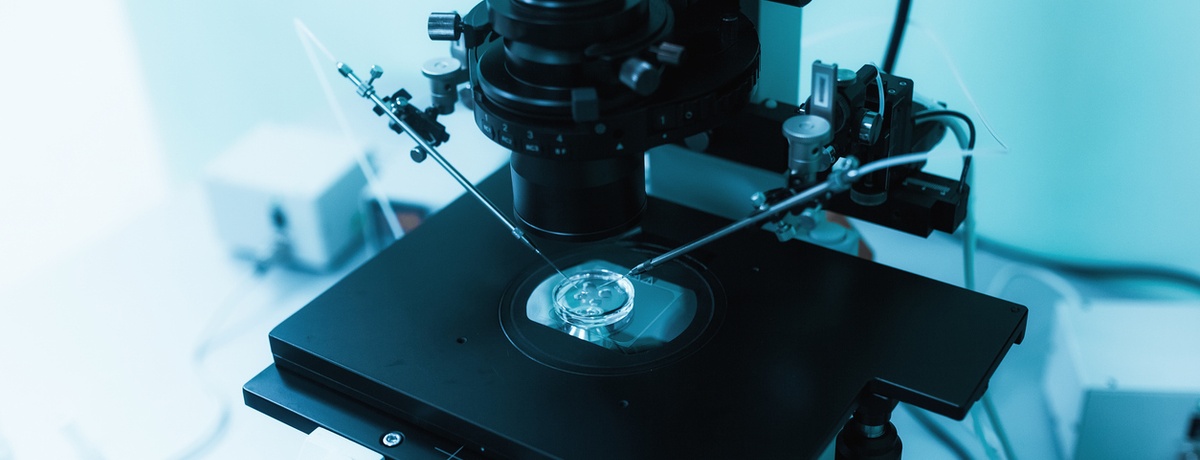
The eggs are fertilised with sperm in the embryology laboratory. Depending on sperm quality and the doctor’s recommendation, conventional IVF or ICSI may be used. With ICSI, the embryologist injects one sperm directly into the egg, which is particularly important in cases of an abnormal semen analysis or previous fertilisation problems.
The resulting embryos are cultured for several days and their development is monitored. Embryologists assess cell division and morphology, and additional laboratory methods may be recommended depending on the situation. Not every egg fertilises and not every embryo develops optimally; the laboratory phase is therefore crucial to the IVF outcome.
5. Embryo transfer
Embryo transfer is the transfer of an embryo into the uterus using a thin catheter. It is usually brief, does not require anaesthesia and is similar to a gynaecological procedure. It can take place in a fresh cycle or as a frozen embryo transfer after the embryo has been thawed.
Correct timing according to the condition of the uterine lining and the overall treatment plan is important. After the transfer comes the wait for the pregnancy test. This period can be psychologically demanding, so it is helpful to have clear instructions from the clinic and not interpret every physical sensation as confirmation or exclusion of pregnancy.
How long IVF takes and when it makes sense to start
From the start of stimulation to egg retrieval, the process usually takes weeks rather than months. However, the total duration varies according to the examinations, type of protocol, preparation of the uterine lining and whether a fresh transfer or a transfer of a frozen embryo is performed. In women over 35, with low ovarian reserve, blocked fallopian tubes, endometriosis or an abnormal semen analysis, it is often beneficial not to delay the consultation.
FAQ
Is IVF painful?
Egg retrieval is performed under short anaesthesia, so the patient does not experience the procedure itself as painful. After the procedure, mild pressure or tenderness in the lower abdomen may temporarily occur, or slight discomfort in the area where the aspiration needle was inserted during retrieval. These sensations are usually temporary and gradually subside.
The subsequent embryo transfer does not require anaesthesia. It is a short and gentle procedure in which the embryo is introduced into the uterus through the vagina and cervix using a thin transfer catheter. Most patients perceive it similarly to a routine gynaecological examination.
How many eggs are needed for successful IVF?
There is no universal number. Not only the quantity but also the quality of the eggs, sperm and embryos is important.
Is a fresh transfer or frozen embryo transfer better?
It depends on the specific situation, embryo quality, the uterine lining, the hormonal setting and the doctor’s recommendation.
Can IVF help with an abnormal semen analysis?
Yes. In the case of male-factor infertility, IVF may be recommended, possibly IVF with ICSI or other laboratory procedures.
When should I book an IVF consultation?
After one year of unsuccessful trying, after six months for women over 35, or earlier if there is a known risk factor.
Book a consultation at the Reprofit clinic – in Brno or Ostrava
If you are dealing with a similar situation, book a consultation at Reprofit. The doctor will review your medical history and examination results with you and propose an approach that reflects your age, diagnosis, available time and expectations. If necessary, this can be followed by a fertility assessment, semen analysis, ultrasound, IVF plan or laboratory methods.
You might also be interested in



Egg donation: Am I a suitable donor? What are the conditions and possible risks